
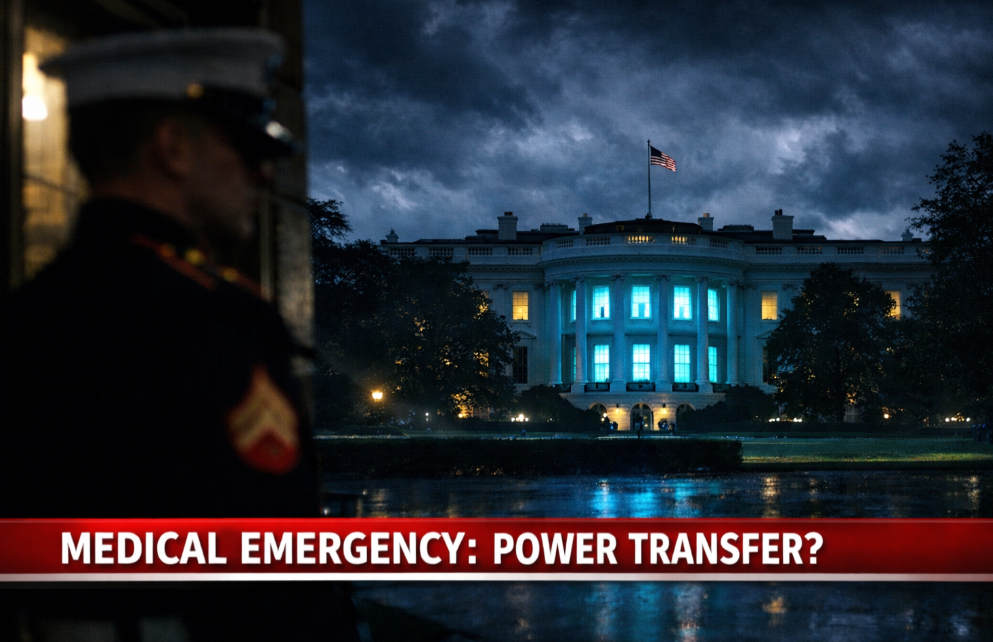
The American political landscape has been thrust into a state of acute uncertainty following reports that President Donald Trump has suffered a debilitating stroke. With the White House medical wing reportedly under lockdown and an emergency power transfer plan surfacing in the halls of the West Wing, the nation faces a sudden, jarring confrontation with the fragility of its executive branch. This development moves beyond a mere medical update; it is a full-scale constitutional test of the 25th Amendment and the stability of a presidency built on the image of singular, unshakeable strength.
The Anatomy of an Information Vacuum
In the hours following the President’s reported collapse, a “controlled chaos” has descended upon the West Wing. Sources allege that the White House Medical Unit has restricted all communication, effectively sealing the executive residence. For a presidency that has curated an image of inexhaustible energy, this suggestion of clinical frailty acts as a political earthquake. In the absence of a formal bulletin, the public is left to parse the meaning of a “sealed scene”—a term usually reserved for tactical operations, now applied to the heart of American governance.
The 25th Amendment and the Shadow of JD Vance
The purported “Emergency Power Transfer Plan” shifts this crisis into the sphere of constitutional law. Section 4 of the 25th Amendment provides the mechanism for a transfer of authority when a president is “unable to discharge his duties.” If these documents are legitimate, they suggest that Vice President JD Vance and the Cabinet are already preparing for an immediate transition. Vance, the intellectual vanguard of the movement, now faces the prospect of assuming the Commander-in-Chief’s responsibilities under a cloud of national trauma and intense global scrutiny.





https://shorturl.fm/j7v4i