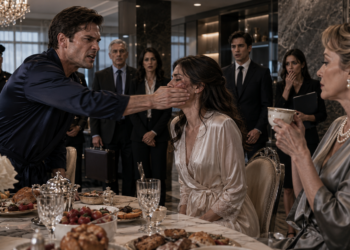
New York’s insular art and social circles thrive on gossip, and the story of Beatrice Sterling’s abandonment by her friends and subsequent arrest in the Maldives spread like a virulent plague. Her three former companions, desperate to distance themselves from a criminal investigation, told everyone who would listen about Beatrice sobbing in a luxury villa as the island security hauled her away. The story was featured in two major blind items in Page Six within forty-eight hours.
To avoid his mother spending a decade in a Maldivian prison for defrauding a high-end resort, Julian was forced into a desperate corner. He had no savings, no assets, and his “muse” Sasha had dumped him via text message the moment he asked her to help pay for his storage unit.
Julian had to go to a predatory, high-risk equity firm and take out a massive, suffocating loan against the only asset the Sterling family had left: Beatrice’s heavily mortgaged, crumbling pseudo-mansion in Westchester. By the time he wired the exorbitant funds to the Azure Atoll Resort to cover the stolen vacation, the damages, and the legal “administrative fees” required to let Beatrice leave the country without an Interpol flag, the Sterling family was entirely, catastrophically bankrupt.
Beatrice returned to New York a pariah. She was banned from her country club for “conduct unbecoming,” ignored by her peers, and terrified to show her face in public. She was a ghost in her own neighborhood, a woman who had tried to steal a queen’s life and ended up a pauper.
Julian, however, attempted one final, pathetic act of defiance. He hired a sleazy lawyer who advertised on subway billboards and attempted to sue me in civil court. His claim? That he was entitled to “retroactive artist maintenance” and a portion of my architectural firm, arguing that his “creative energy” had inspired my designs, and that my sudden withdrawal of financial support was an act of “domestic economic abuse.”
I didn’t even have to put on a suit to attend the preliminary hearing.
My attorney simply slid three documents across the judge’s desk. The first was our prenuptial agreement, which Julian had eagerly signed years ago when he naively believed his art would make him a billionaire. The second was a thick folder of time-stamped photographs proving his infidelity in my apartment. The third was a copy of the active NYPD police report detailing his mother’s felony theft of my concierge tablet and the resulting international fraud.
The judge, a stern woman named Justice Halloway with zero tolerance for frivolous litigation, spent three minutes reading the file. She looked up, adjusted her glasses, and stared at Julian with open, unadulterated disgust.
“Mr. Sterling,” the judge said, her voice echoing in the quiet courtroom. “The only ‘creative energy’ you have demonstrated here is your profound capacity for delusion. This lawsuit is baseless, harassing, and frankly, insulting to the court. Case dismissed with prejudice. And you will be paying Ms. Rostova’s legal fees in full. I am also referring your mother’s case to the District Attorney’s office for a final review.”
Julian stood there, his jaw slack, the remaining shreds of his pretentious ego dissolving into dust. He looked at me, his eyes pleading, searching for the woman who used to pay his bills. I didn’t look back. I simply gathered my files and walked out of the courtroom, leaving him to suffocate in the vacuum he had created.
I threw myself back into my work. My firm flourished. I won the bid for the museum. I expanded my team. I forgot about the Sterlings entirely.
Until exactly one year later, when a very specific, heavy legal envelope landed on my sleek glass desk. It was the final chapter in the demolition.
Chapter VI: The Demolition and the Foundation
It was a crisp, brilliant Tuesday morning in October. Central Park looked like a sea of fire and gold from my penthouse office windows.
My lead attorney, David, sat across from me, a smug, satisfied smile playing on his lips. He pushed the thick legal document out of the envelope and across the glass surface toward me. I picked up my platinum fountain pen and looked at the address printed at the top of the deed of transfer.
It was the sprawling, decaying Sterling property in Westchester.
Beatrice, completely unable to meet the crushing monthly payments on the predatory loan Julian had taken out to save her from the Maldivian police, had finally lost the battle. The bank had foreclosed on her beloved mansion. It had gone to a private commercial auction the day before.
Through an anonymous shell corporation, I had purchased it for a fraction of its former value.
“The title is clear, Elena,” David said quietly. “The property is completely vacated. The bank evicted them last week. Your signature finalizes the acquisition. They are currently living in a two-bedroom apartment in Queens, directly above a loud Greek restaurant.”
I heard through the grapevine that Julian had finally been forced to face reality. With no studio, no wife to fund him, and massive legal debts, he had abandoned his “conceptual art.” He was currently working the evening shift as a bartender. The delicious irony was that the bar was located in the basement of the very same Chelsea art gallery where he used to strut around in expensive suits, pretending to be a prodigy while drinking the champagne I paid for. Now, he was the one wiping down the sticky counters and serving drinks to the people who used to flatter him.
Beatrice was reportedly a shell of her former self, spending her days complaining about the noise of the gyro spit downstairs, completely isolated from the elite society she had worshipped her entire life.
They had thought I was merely a “tradeswoman.” They had mistaken my love for foolishness, and my generosity for weakness. They didn’t understand that an architect doesn’t just build; an architect knows exactly which load-bearing pillars to remove to bring a rotten structure crashing down to the earth.
“What are your plans for the property?” David asked, watching me uncap the fountain pen. “Are you going to flip it? The land alone is worth triple what you paid.”
“No,” I said softly, staring at the deed. “The foundation is bad. The history is tainted. The design is archaic. It’s entirely unsalvageable.”
I pressed the nib of the pen to the heavy paper, signing my name with a smooth, aggressive flourish.
“I’m going to demolish it,” I told him, a genuine smile finally breaking across my face. “I’m going to bulldoze the entire estate down to the dirt. Every brick of their ‘legacy’ will be ground into gravel.”
“And then?”
“And then, on that dirt, I am going to design and build a state-of-the-art retreat and residency program for young, female architects. A place for women who actually build things. A place for women who know the value of a solid foundation.”
David chuckled, gathering the signed documents. “A fitting end, Elena.”
“A new beginning,” I corrected him.
I stood up and walked over to the floor-to-ceiling windows. I looked out over the empire I had built with my own two hands, my own vision, and my own relentless drive. The air up here was thin, cold, and absolutely pure. I had excised the parasites. I had survived the betrayal.
And as I looked down at the city, I realized that the best part of tearing down a toxic past wasn’t the revenge itself. It was the vast, beautiful, empty space it left behind, just waiting for me to build something magnificent in its place.
But as I turned back to my desk, my assistant buzzed. ‘Elena? There’s a woman here to see you. She says her name is Sasha. Julian’s former “muse.” She says she has a collection of scrap metal sculptures that Julian was hiding… sculptures he stole from your grandmother’s estate.’