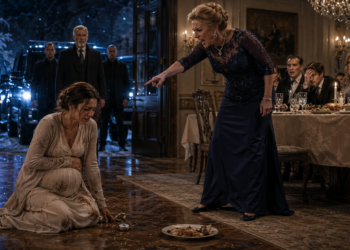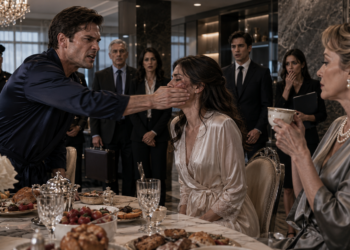
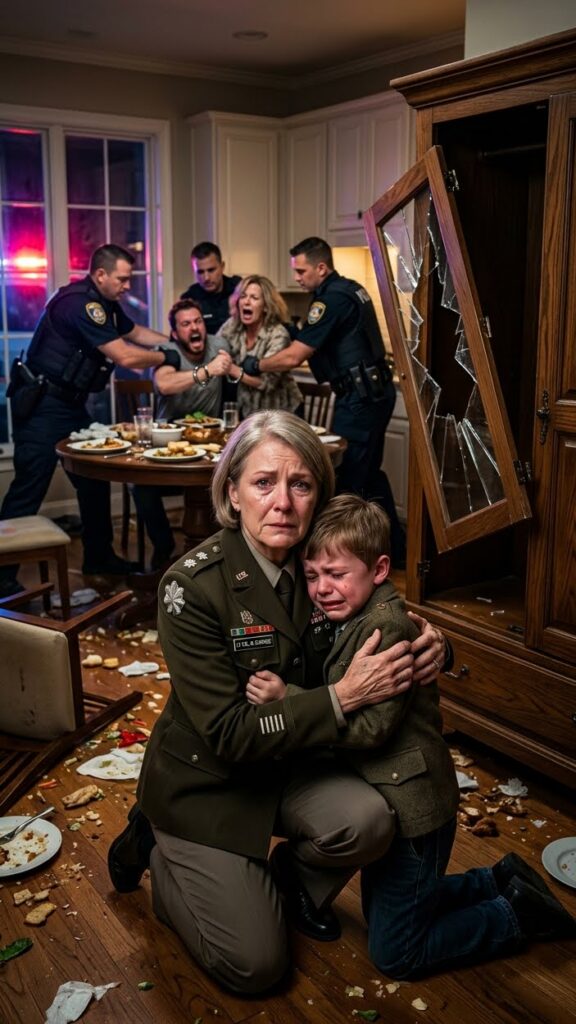
The rain lashed against the floor-to-ceiling windows of the isolated suburban mansion, sounding like handfuls of gravel thrown by an angry god. Outside, the world was swallowed by the blackness of a severe thunderstorm, the trees thrashing wildly in the wind. Inside, however, the dining room was an oasis of climate-controlled, soundproofed arrogance.
Warm amber light from the designer chandelier spilled over the remnants of an expensive dry-aged Ribeye steak, half-empty glasses of Cabernet, and the self-satisfied chuckles of my son-in-law, Richard, and his mother, Eleanor.
From my position at the kitchen sink, the warmth of the house felt entirely artificial. The air back here was thick with the smell of scorched butter and the heavy grease of the meal I had just prepared for them.
“Richard, darling, this cut of beef is simply spectacular,” Eleanor purred, her voice easily cutting through the low hum of the refrigerator. “Though I suppose the presentation could be a bit more refined. One can’t expect a Michelin-star plating from a live-in babysitter.”
“She does her best, Mother,” Richard scoffed, the sound wet and lazy with expensive wine. “Hey, Evelyn! Bring out the rest of the horseradish sauce. You forgot it on the counter.”
I picked up the crystal condiment bowl, my hands perfectly steady. They were old hands, marked by age spots and mapped with faint, silvery scars, but they didn’t shake. They hadn’t shaken in thirty years, not since my final deployment with the Special Operations Surgical Team in Fallujah.
I pushed through the heavy oak swinging door.
“Here you are,” I said quietly, placing the small bowl next to his plate. I made a slight motion to pull out the empty chair across from Richard—a chair I used to sit in before my daughter’s shifts at the hospital became so demanding.
Eleanor cleared her throat. It was a sharp, grating sound, like a knife slipping on a porcelain plate.
“Evelyn,” she said, her eyes fixed pointedly on her wine glass. “Richard and I are discussing private family matters. His new portfolio. Why don’t you take your plate back to the kitchen? There are plenty of scraps left near the bone.”
I looked at Richard. My daughter, Chloe, was currently saving lives in the ER during a double shift. She thought I was living in this sprawling, high-tech fortress as a cherished grandmother, recovering from a “minor cardiac event” (my fabricated cover story for a lingering shrapnel ache). She had no idea that her husband treated me like the hired help. She didn’t know her mother-in-law looked at me like dirt tracked onto a Persian rug.
“Yeah, go ahead, Evelyn,” Richard muttered, waving his fork dismissively. “Let us talk. And make sure the kitchen door is shut tight. I don’t want to smell the dishwater.”
I didn’t argue. In my former life, you never interrupted a hostiles’ false sense of security. You let them gloat. You let them drink. You let them believe they are the apex predators right up until the moment you sever their supply lines.
I returned to the kitchen. I stood by the marble island, eating cold, gray slices of beef off a paper towel. But I wasn’t tasting the food. My mind was mapping the house.
Something was fundamentally wrong tonight. The mansion was too quiet.
“Where is Leo?” I had asked two hours ago. Richard had vaguely mentioned a “strict time-out.”
My grandson was five years old. He was a vibrant, noisy boy who practically vibrated with energy. He didn’t do quiet time-outs. If he was in his room, I would hear the dull thud of his dinosaur toys hitting the floorboards.
There was nothing. Just the violent drumming of the rain against the glass.
And then, during a brief lull in the thunder, I heard it.
It was incredibly faint, originating from somewhere beneath my feet. A frantic, rhythmic scratching.
Scritch. Scritch. Gasp.
It wasn’t coming from the upper floors. It was coming from the basement. Specifically, Richard’s prized, temperature-controlled wine cellar. A room with heavy insulation and a biometric lock.
I put down my food. I walked to the kitchen door and opened it just a fraction of an inch.
“He’s been down there for over two hours, Richard,” Eleanor was saying, her tone laced with a twisted sort of pride. “Do you think he’s learned his lesson?”
“He needs to understand consequences, Mother,” Richard replied coldly. “He scratched the bezel of my Rolex with that stupid toy car. A thirty-thousand-dollar watch! He’s too soft, always crying. A little time in the cold and the dark will toughen him up. Break that weak spirit his mother coddles.”
“I completely agree,” Eleanor sniffed. “He acts just like that old woman in the kitchen. Passive. Fragile. Pathetic.”