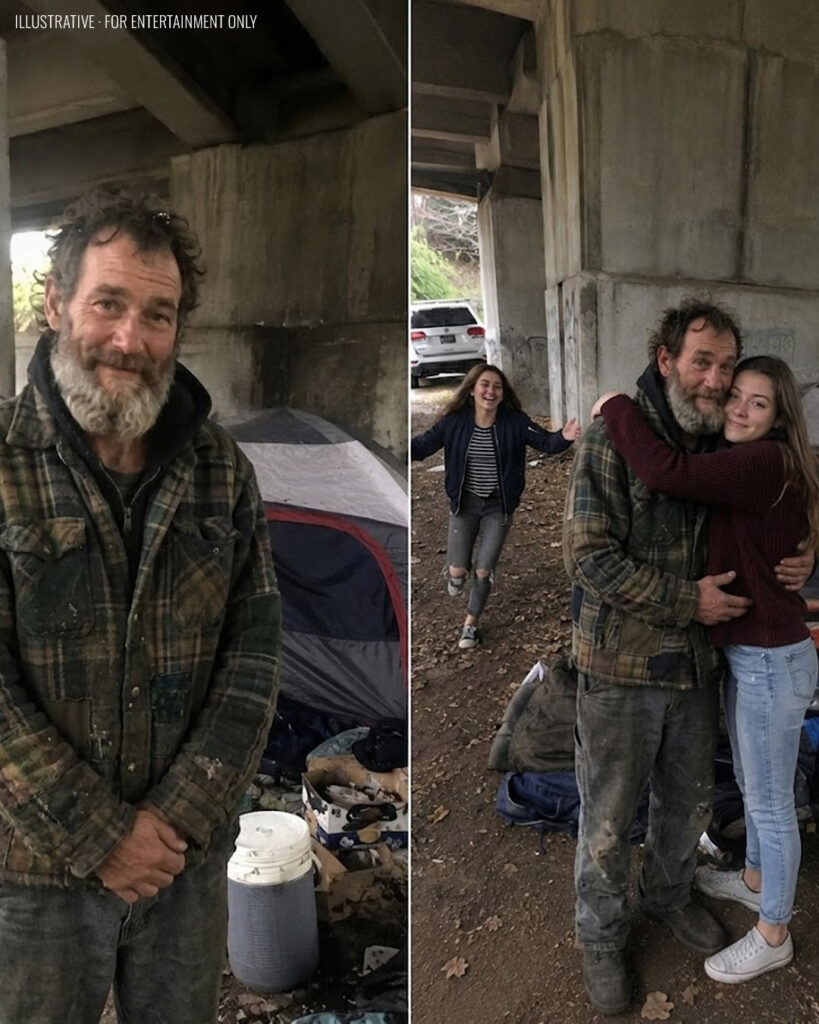
After waking under a bridge with blood on his jacket and no memory, Fred rebuilt his life through odd jobs and quiet survival. But when a café owner recognizes his face, a white SUV soon arrives with two girls who reveal the heartbreaking truth.
Advertisement
I don’t even know my real age. Maybe 50. Maybe 60.
People used to ask me that like it was an easy question, like my birthday was tucked in my coat pocket beside a few coins and an old receipt. I would just smile, rub the back of my neck, and say, “Somewhere around tired.”
They laughed when I said that. Most folks thought I was joking.
I wasn’t.
Thirteen years ago, I woke up under a bridge with blood on my jacket and absolutely no memory of who I was.
Not a foggy memory. Not a blurred one. Nothing.
I opened my eyes to the sound of trucks rumbling overhead and cold concrete digging into my spine. The air smelled like rainwater, engine oil, and damp cardboard. My head throbbed so hard that I could barely lift it.
When I looked down, I saw dark stains on my jacket. Blood. Some of it dried, some of it stiffened in the fabric.
For a few minutes, I just sat there, waiting for my own name to arrive.
It never did.
There were men sleeping nearby, wrapped in blankets and old coats, their faces hidden from the morning chill. One of them had a gray beard and a shopping cart full of plastic bags. Another was sitting up, drinking from a paper cup.
I remember asking the other homeless guys, “Do you know me? What happened to me?”
The man with the paper cup squinted at me. Then he laughed.
“Buddy, you’ve been here for years already. Quit pretending you forgot everything.”
A few of the others chuckled, too.
Not cruelly, exactly. More like they had heard every kind of story a man could tell when he had nothing left.
At first, I thought they were joking.
I kept asking questions. What was my name? Had I been hurt? Did anyone come looking for me?
One man told me people called me Fred because that was what I answered to one night when someone asked. Another said I had always kept to myself. A third said maybe I drank too much and scrambled my brain.
But I didn’t feel drunk. I felt empty.
Days turned into weeks.
Weeks turned into months. Months became years. Still, nothing ever came back.
No family.
No name.
No past.
I learned to live with a life that began on wet concrete.
That sounds easier than it was.
At first, I searched faces everywhere.
I looked through the bus windows. I stared at mothers holding children’s hands. I watched men in suits cross the street and wondered if one of them had once known me.
Every time a woman paused near me, my chest tightened. Maybe she would gasp. Maybe she would say, “There you are.”
No one ever did.
Eventually, hope became heavier than hunger, so I stopped carrying so much of it.
Still, I never wanted to survive by begging.
I don’t judge anyone who does. Hunger can bend the strongest person. Cold can make pride feel silly. But something inside me refused to sit with a cup in my hand and wait for mercy.
So I worked.
I cleaned parking lots before sunrise, dragging trash bags heavier than my arms wanted to lift. I carried boxes at warehouses for men who paid me cash and never asked for papers.
I painted fences in backyards while dogs barked at me through screen doors. I trimmed hedges for old couples who watched from windows and slipped me sandwiches wrapped in napkins.
Anything people would pay cash for, I did.